Thursday, February 14, 2013

A Response to the Backlash Against 'Slumdog Millionaire'

(This is an old piece of writing that I am re-posting on Cactus Chronicles:)


I saw the movie in November in a small theatre that usually screens only indie films, and I enjoyed it on many levels. Weeks later, when it had hit the mainstream theatres and everybody had an opinion on it, I was surprised that there was so much of negativity surrounding the movie. To me it was a film that was essentially about determination and a boy holding on to the hope of finding his love, in a setting of poverty and squalour.

My interest in this issue is on 2 levels: As an aspiring writer, it alarms me that there are artistic boundaries that cannot be crossed in peoples' opinions. Vikas Swarup evidently crossed those, and Danny Boyle and his crew skillfully gave us a collective imagination of those boundaries. 
Secondly, the fact that a movie can be so polarizing, makes me want to dig deeper into the reasons why. If we begin with the assumption that everybody is "against" poverty and the abuse of children, how then did some people thoroughly enjoy the movie (like I did), and some think it vile and an example of 'poverty pornography', a term vile in itself?

So for those of you who think that poverty was somehow exploited in the movie/book: Are you now going to decry all books in which the protagonist is in a deprived setting? A good number of classics will have to be pulled off the shelves. You can begin with Oliver Twist! 

You must also not watch crime scene dramas. They too are exploitative for the following reasons: They are not realistic in that not all murders are solved. There are a multitude of unsolved crimes, with murderers and rapists still at large. Families are still waiting for children, wives, husbands, brothers, daughters who will never return home. The entertainment industry capitalizes on social ills to come up with plots that captivate the average viewer looking for a rush of adrenalin while sitting on his couch. Lets call it Adrenalin-rush pornography!! So the next time your favourite Crime Scene Drama comes on, turn the TV off!

The same applies to Medical Dramas. There are enough uninsured people in the US, many of them children, to warrant the application of the same sentiments underlying the uproar against Slumdog. Medical dramas tend to paint a healthier picture of things, no pun intended. They don't always show the number of families who enter hospitals with their loved ones, but leave without them, due to incurable disease, or even negligence. They don't show the thousands of patients who can't afford the treatment they need. They only show what will fly in the name of entertainment. And if you have thought this through carefully, you should know that the Television Industry exploits! So the next time your favourite doctor flashes his/her smile on your television screen, switch to the History Channel. That's your safest bet!!

And if your idea of entertainment is to step away from reality, and only watch movies that portray an India that has been filmed on the hillsides of the Alps, where the streets have no beggars, (much less blinded or mutilated ones), that's fine - because that IS the purpose of entertainment - to get away from the grimness of reality for a few hours. But don't deny a film the power to entertain via realism. Or magical realism. 

Satyajit Ray was criticized by some for his style of realism and for "exporting poverty" to the west. If you are a part of that bitter bandwagon that thinks that realism panders to the tastes of the west, and that escapism and posturing a la Bollywood is the only Indian way of filmmaking, you are wrong. Just because Bollywood churns out more movies in numbers, their style isn't intrinsically authentic. It's time that realism too be recognized as an authentic style of (Indian) film-making, and that any deviation from the Bollywood formula not be looked upon as a way to just get "creative Global recognition" as suggested by Bollywood Bigwigs!

I think it is unfortunate that the name Slumdog has been received badly in India and by Indians abroad. A term coined by Simon Beaufoy, and an amalgam of underdog and slum, ironically, it has been lost on the citizens of the land of Sanskrit, known for its sandhis. That the residents of Dharavi and other slums are sensitive to the use of a word that is not in employment by the locals to refer to themselves, is understandable. But Slumdog Millionaire is not an expose on Dharavi, nor is it a documentary. It is fiction! And if writers, artists, directors are to work within boundaries that are so subjective, then that is equivalent to creative censorship.

What is it about poverty that makes a certain proportion of Indians want to shoot the messenger? Especially if he's white! I think what is most offensive about Slumdog Millionaire is not its employment of a setting of utter squalour, but the reaction of people to it. Who having spent any extended time in India can deny having seen not just beggars on the street, but sometimes blind or mutilated ones? I was happy that the film provided me with plausible answers to questions that have crossed my mind during some point in my life encountering a scarred beggar: Have they been maimed to garner extra sympathy and bring in more cash while begging? 

So instead of being outraged that the movie was set in a slum and showed the seamier side of India as a part of the plot, be outraged that such things exist!


CVX5445XRFRJ

Friday, February 8, 2013

The Problem With Women


Since the Dec 16th gang rape in New Delhi, there has been much commentary about the status of women in India. Many have pointed out that we are all witting and unwitting collaborators in perpetuating subtle and arrant practices of discrimination against women. From cultural ‘lakshman rekhas’ or boundaries that prevent or discourage women from participating actively in society, to social customs that dictate appropriate behaviours for women, especially in the areas of morality, sexuality, and dress code, there’s ample evidence that there are dual and separate standards for the two sexes. When the problem is everywhere, and all pervasive, as is the issue of women’s status in India, the solution must also be one that can be applied everywhere and in a pervasive manner. Top-down solutions are capable only of  ‘trickle-down’ effects, and not capable of larger brush-stroke changes. For a solution to bring about meaningful alterations within a single lifetime, it must begin with a broad base that is common to women of all ages, socio-economic, educational and ethnic backgrounds.

So how does one even begin to think about solutions to a problem that can be described as: Changing the perception that women can be violently abused and then discarded as trash – from a moving bus? While this description pertains to the specifics of one recent and well-publicized incident, the gist of it applies to a million more. The key elements are that women are abusable and then expendable. In its extreme form, the dispensability of women is nowhere more evident than in the practice of sex-selective abortions and female infanticide. This is a crime in which women are equally culpable as men. When expendability is applied to adults, we see dowry deaths and bride/wife-burning. We see suicides by victims of rape, where the lack of recourse to justice and shame over the violation contribute to sending the woman down the path of complete self-destruction.  Manifestations of abuse are too varied in manner and severity to peg into a few categories, but the most prominent one, high on the severity scale is rape. It has proved to be so successful as a tool in acquiring control and power that it is now a much relied upon “weapon” of warfare in some parts of the world. Questions that have no simple answers are: Which type of rape is more dysfunctional – the one committed in isolation for no apparent tangible gain, or the ones committed as a part of a larger strategy to gain power? How are they different, and what do they have in common? On a moral level, they are both equally vile. On a social level, rapes that are not committed as a means to some larger end are perhaps more disturbing, and indicative of greater social dysfunction than the ones committed for obvious gain. What they both share in common, though, is the recognition by the perpetrators that women can be easily manipulated to work against themselves. Why else would victims of rape be subjected (by men and women) to so much shame and self-recrimination?

A paradigm shift in perception is required before any substantive changes can be observed in the position of the beleaguered women. This paradigm shift is not only about how men view women, but especially how women view themselves and other women.

A person’s identity is a complicated amalgam of associating oneself with many social groups and social roles. Social Identity Theory describes identity as the outcome of highlighting the similarities with members of the in-groups and exaggerating the differences with members of the out-groups. In trying to understand worldwide rape statistics, post-rape suicide, female foeticide/infanticide and non-violent manifestations of female oppression in the context of social identity, it is easy to see that women’s self-perception should be the logical starting-point of remediating efforts. Gender-identity should stem from meaningful differences between the sexes, and not be clouded by a blind quest for “equality.” Gender-identity should celebrate the unique characteristics, capabilities and limitations of the “weaker sex,” and not be defensive about women’s obvious conflicts of interest when motherhood and career overlap for her maximum attention. And lastly, gender-identity issues should be framed in neutral language that avoids connotations of otherness and exclusion. 

An elaboration in the next segment….

Wednesday, January 23, 2013

The Feminine Mistake


In February of this year, it will be 50 years since the publication of Betty Friedan’s The Feminine Mystique. Feminism in the West is said to be past its third wave or incarnation. In 2012, the world witnessed many events that might indicate to the naïve observer that the western woman has arrived. Sheryl Sandberg, the COO of Facebook became the first female member of its board of directors. Marissa Mayer was appointed president and CEO of Yahoo! As a putative reflection of the times, Hanna Rosin published The End of Men. Yet, there were other indications within the US and worldwide that gender equality moves in paradoxical directions. Here is the first installment of my thoughts on the issue.

I have never been comfortable calling myself a feminist. And there are things about the feminist movement that haven’t resonated with me. For starters, I dislike the term feminism and its derivative, feminist. I’d much rather call myself an “equalist,” if I have to use a label. The term feminism has negative connotations. The word itself implies some kind of deviation from the norm. Am I imagining this negativity? Perhaps not.  There are many words ending in –ist that are somewhat neutral in their connotations. The suffix -ist is often used to denote a profession (manicurist, dentist, artist), a hobby (philatelist, numismatist), a religious affiliation (Baptist, evangelist, atheist), or an attribute of a philosophical, literary or political movement (romanticist, Marxist, colonialist, fascist, realist), to give a few examples. In the case of these words, any negative (or positive) associations are a result of the reputation of the root word itself that the –ist attaches to. For example, the words capitalist, socialist, and communist might have differing values on the positivity scale depending on whether you ask someone in China, the US, or elsewhere, where communism, capitalism and socialism are viewed with differing degrees of approval. In the case of feminist, however, the word comes laden with negative connotations even before the feminists have had a chance to damage their reputation.

 My etymological gripe stems from the fact that the words feminism and feminist describe the quality of the “other” and not of the mainstream - much like how the word racist indicates the deviance from the desired norm of not discriminating on the basis of skin color. Similarly, when you believe in the superiority of a group, especially racial, you are a supremacist - another word that implies a deviation from the mainstream. If you are overly self-centered, you are an egoist. One can even deviate from the norm on the positive side of the spectrum: If you are unselfishly concerned about others, even at your own detriment (definitely not a common attribute,) you are an altruist.

I believe that parity between the sexes ought to be the norm. Why then begin with a word that implies a minority viewpoint?

An additional problem with the current terminology of feminism lies in the answer to the question: Can men be feminists? According to Brian Klocke elaborating on this question on the NOMAS website (National Organization for Men Against Sexism,) “Although I believe that men can be pro-feminist and anti-sexist, I do not believe we can be feminists in the strictest sense of the word in today's society. Men, in this patriarchal system, cannot remove themselves from their power and privilege in relation to women. To be a feminist one must be a member of the targeted group (i.e a woman) not only as a matter of classification but as having one's directly-lived experience inform one's theory and praxis.”

One does not have to be a person of color in order to advocate for racial equality or to be called “not racist.” Thus, the requirement of having “directly-lived experience” is nullified if the struggle for parity between the sexes is framed in terms of a neutral idea such as “gender equality.”

The power of a single word must not be under-estimated. It can steer, derail or hijack a movement in subtle ways.

Saturday, December 1, 2012

On The Death Of My Father - Part I


 My father with my grandparents. Circa 1936

Part I

As someone who is skeptical about the survival of the soul beyond the life of the body, my father's death is an event of finality. I don't believe that he is watching us from anywhere. I have no expectation or hope that I will be reunited with him in some happy hereafter. And I do not try to convince myself that the accident of his birth and all our births is proof of some magical permanence of his spirit. The only mystical remnants of my father’s existence are the individual and shared memories that we have of him. And even those are not absolute. Not only are our memories shaped by our own perspectives and biases, they are subject to modification and degradation. Perhaps that is why I hold onto my memory of my father as if it were an entity in itself, waging its own war against time, to survive.

My father was a quiet person who enjoyed his privacy. He was talkative only when he chose to be - with close family and in select company. As a person who didn't freely display his thoughts, and especially as someone who didn't impose his opinion on others, it was not obvious to me that my father had had a deep influence on people outside my immediate family. Children tend to view their parents' lives lopsidedly. We tend to minimize all the influences that existed in our parents' lives before our birth. It's all about us, and the time since we have been around. When my father died, my grief and that of my immediate family was understandable. But it was a revelation to me that when the quiet and unobtrusive nature of my father’s life came to an end, there were others, grown men and women far removed from my father’s daily-life interactions who would feel a sense of loss akin to mine. It was a lesson that my father had had a life well beyond the boundaries of my existence.

My father rarely preached about what he believed in, or what he wished to emphasize. He led by way of example. If he wanted his children to be kind, generous or hospitable, he never said so in words. Instead, we saw how he opened his house to guests with genuine warmth. He shared his home, our home, for several years with a friend who came upon hard times. He was a father figure to his younger cousins. He was the “go-to person” for questions and problems of all kinds – monetary and otherwise. He was the perfect combination of knowledge and kindness that ensured, that no matter what your query, you would never leave empty-handed. And sometimes you would leave with more than you bargained for! Those who have approached him with questions know that if all you had in mind was a quick, summary answer, he subjected you to a thorough background on the topic before delving into the core of your question.

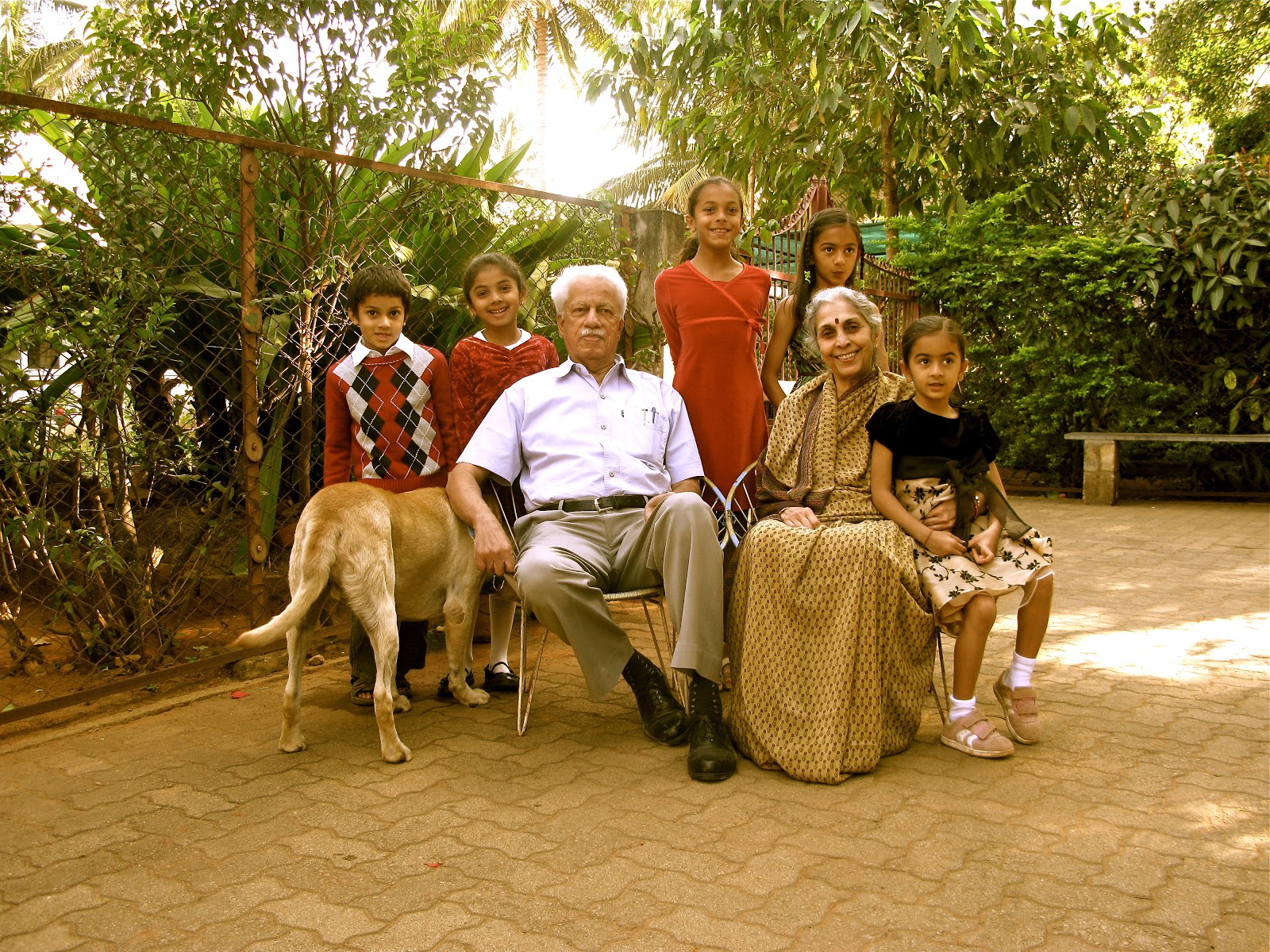
With all but one of the grandkids. 2005.


I was absent for most of my father’s illness and treatment. In the nine months that he lived after receiving a terminal diagnosis, I only spent one month with him at a time when he still felt and looked well. I never got to see my father during his episodes of deterioration, with the exception of the end. I was the long-distance observer whose contribution towards caring for my father was restricted to phone-calls. In turn, I had to content myself with frequent updates from my family as the only means of giving and receiving support. As the outsider, physically removed from the center of activity, and unable to control or contribute to daily issues surrounding my father’s illness, I was occupied with other concerns. While the proximal caregivers hold on to the hope that the treatment will prolong life, the distal ones must confront additional (and opposing) possibilities, - not on account of any inherent pessimism, but because a distance of 10,000 miles guarantees a reaction-time delay of at least 24 hours. So I had to mentally prepare myself for the possibility that I might never see my father alive again. Or the possibility of having to rush to India for a funeral and rush back in the middle of the school term, when taking extended time off from classes would be difficult. I consider myself fortunate that neither of those scenarios played out. I like to believe that the timing of my father’s death was somehow cognizant of my limitations and responsibilities. My father’s health began to take a rapid turn for the worse the day I posted my grades, and when my teaching commitment for the term had ended. I left for India two days later, and had the luxury of spending most of the summer-break with my family. I was spared the ordeal of having to grieve on my own in the days immediately following my father’s demise.


         In his final days, due to a collapsed lung, my father needed to be on pressurized oxygen. The oxygen mask, which was tightly strapped around his face left pressure sores. His eyes were closed – the mask made it difficult to keep his eyes open.  Insufficient oxygen and a build-up of carbon dioxide made him drowsy; he drifted in and out of periods of wakefulness and sleep. When I arrived at the hospital, he seemed awake and aware. He acknowledged my presence with a ‘thumbs up’ sign from one hand. Then he gestured – rotating both his palms. I could not understand what he meant. Sundar, his protégé, confidant, friend – a relationship that defies being pegged as one thing – translated for me: “He wants to know how long you’re staying.” “I’m here for two months,” I answered. My father then responded by sticking two thumbs up in the air. This was the last “conversation” I had with him.

 With Viren. Dec 2011.

My father was educated as an engineer, but he sustained a long-standing interest in a wide range of subjects from languages to astronomy to electronics to UFOs to medicine. On the day before he died, the oncologist taking care of him joked with my brothers by my sleeping father’s bedside. He commended my brothers for their attention to detail in the care of my father, and referred to my brothers’ knowledge of medicine as being like that of “medical students…” “But your father,” said the oncologist, “is like a post-graduate!”

 Our brains are supposedly wired to process some kinds of information better than others (verbal, visual, numerical, spatial...) If people are considered talented in a certain area of expertise, it is likely an ordinary merit. Usually, this aptitude comes with a price – namely, a compensatory lack of proficiency in another area. How many mathematicians are also artistically or linguistically proficient, and conversely, how many artists, writers and musicians can manipulate numbers with ease? Not many. They are the truly talented. My father belongs in that category.

Some part of the sadness that I feel doesn’t come from the loss of a father-daughter relationship. It comes from the sense of loss one feels when the world loses an extraordinary person. I just happen to be his daughter.

I sometimes think of my father's life as a series of languages. Tamil, English and Marathi in his early childhood; Kannada, Hindi and Sanskrit in his later youth; exposure to Bengali as a young adult; German and French in his twenties; efforts at learning Italian through books and a brief stay in Italy; self-taught Spanish in his seventies. He was not a talkative man to those who didn't know him well, but he never passed up the chance to initiate a conversation in order to indulge his affinity for languages. Whenever he met someone who could entertain his enthusiasm, he was ever ready to dig up phrases or retrieve functional communication in languages he had long lost exposure to. His conversation partners would commend his remarkable linguistic skills, but my father viewed his retention of languages as if it were like riding a bike – once learned, it could never be forgotten, even if you have not ridden for years.  My father always had a reputation for being an adept language enthusiast. As a child, I took this reputation for granted, as most children do, without questioning or evaluating it for myself. But it is only as an adult, stumbling and hesitating through my own (and much smaller range of languages that I speak or understand) that I got to fully appreciate the ease with which my father navigated the multiple channels of his linguistic repertoire.

On the news of his death, a cousin of my father, who, over the years, occasionally sought his help in matters of language (translation between English and German) wrote a letter that reflects the awe that I feel for my father’s linguistic capacity. She wanted me to read her letter (which was addressed to my father) during one of the last rites performed for him (which I did not get a chance to do.) So here it is, instead. I hope my translation from the German in which she wrote it, is accurate.

Grüß Gott Jayaram,
Where have you gone without bidding goodbye to us? Was it a call from God that you had to accept it? I did not have the slightest idea that you were so ill, because you looked so well the last time we met. We talked a lot about the German language. I asked you what the expression “Früh übt sich” meant. Whenever I had questions, I came to you, or just sent you a message. And there was your answer! What are you? A language-genius! A king of the German language! Or better yet, an Emperor! I really don’t know what I should call you. You are an extraordinary person with the most pleasant qualities such as your ever-readiness to help and your kindness.
I always remember the translation project that we worked on together. Not only was it fun working on the project with you, but I also had the opportunity to learn so much.
Now Jayaram, tell me, whom should I turn to when I have questions? You will be missed. Perhaps we will meet again in heaven!
Your sister,
S
If I had known that you were so gravely ill, I would have spent more quality time with you.
S


My father was my first writing teacher. As a child, whenever I missed school, I would have to write my own letters of absence, or “leave letters” as we called them. When I was very young, my father would dictate the contents of the letter, and I would write it in my own hand. Later, as I grew older, and more familiar with my father’s turn of phrase and style of transforming conversational language into its formal, epistolary counterpart, I would write the letters on my own, - to be then modified, approved and signed by my father. If in my own writing I use ten words where three would suffice, it is a trait I learned from him. In his personal correspondence, in letters to friends and relatives, and in his emails, he always erred on the side of clarity. He readily sacrificed being brief to making sure he was clearly understood. If in person my father appeared to be a man of few words, in his writing he was the complete opposite. 

December 2008