Monday, June 29, 2015

BEWARE THE BOBBY JINDAL


Bobby Jindal’s announcement that he will be competing for the 2016 GOP presidential ticket is being met with mixed emotions by the Indian community. Jindal has already secured the distinction of being the first person of Indian heritage to serve as governor of a US state – for two terms, no less. This is a position he gained by winning a very large margin over his opponents – no small achievement in the southern state of Louisiana that has a long history of racial tension. No matter the outcome of his run for presidency, Jindal is the first of his kind to have accomplished what he has so far.

However, any pride that the Indian community may feel that a person of Indian origin has come so far in America’s political echelons is misplaced, and should be tempered with the reality that Bobby Jindal is not the typical Indian immigrant. As Shashi Tharoor, former Under Secretary of the United Nations has noted in his latest book, India Shastra: Tharoor asks “How proud should we be of Bobby Jindal?” and answers “Let us be proud that a brown-skinned man with an Indian name has achieved what Bobby Jindal has. But let us not make the mistake of thinking that we should be proud of how he behaves, or what he stands for.”

Jindal was born Piyush Jindal, but at the age of four, he asked to be called Bobby, after the youngest character in the television show The Brady Bunch. Apart from rejecting the name given to him by his parents (although legally he still is Piyush), Jindal has openly dissociated himself from his Indian heritage. In his teens, he converted from the religion of his birth, Hinduism, to Christianity. He dislikes being called “Indian-American” and prefers the term “American.”  As Tharoor clarifies in India Shastra: “…Bobby has never supported a single Indian issue; he refused to join the India Caucus when he was a Congressman at Capitol Hill, and is conspicuously absent from any event with a visiting Indian leader. It is as if he wants to forget he is Indian, and would like voters to forget it too.”

If Jindal wishes voters to forget that detail about his origin, Indians on the Twitter-sphere have not.  Following Jindal’s announcement to run for president, Indian American comedian Hari Kondabolu began the flurry of tweets mocking Jindal with the hashtag #bobbyjindalissowhite:


While the comment above was tweeted in jest, Kondabolu may have accidently hit upon a truth: Tharoor states, on a serious note, in India Shastra (about Jindal) that “The two of us jointly won something called an Excelsior Award once from the Network of Indian Professionals in the US, and his acceptance speech on the occasion was striking – obligatory references to the Indian values of his parents, but a speech so American in tone and intonation that he mangled the Indian name of his own brother.” 

Another tweet from Kondabolu reads:


And another, on a half-serious note:


Adding to Kondabolu’s hashtag, The Daily Show’s Aasif Mandvi created the hashtag #Jindian as the Indian version of “redneck,” and tweeted the following:


This last tweet is in reference to the controversy regarding Jindal’s unofficial portrait done by Louisiana painter Tommy Yow Jr. from a photograph of Jindal, where the skin tone on the portrait is several tones lighter than the skin of the real Jindal. This portrait has been hanging in the Louisiana Capitol office since 2008, but people took notice only in February of this year when a blogger tweeted a picture of the portrait causing an onslaught of comments and jokes.

While the jokes about Jindal’s choices of personal identity are entertaining, what is not so amusing is Jindal’s stance on political issues. It is Jindal’s option to associate with or dissociate from whomever he pleases. However, if the Indian community were better aware of Bobby Jindal’s political opinions, the majority would rather he not be associated with the Indian diaspora.

According to 2012 statistics from The Pew Research Center, 65% of Indian Americans are Democrats or left-leaning; 18% are Republican. As a conservative Republican, Jindal stands severely opposed to the prevailing values of the Indian community. As Tharoor notes:

“Most Indian-Americans are in favour of gun control, support a woman’s right to choose abortion, advocate immigrants’ rights, and oppose school prayer (for fear it will marginalize non-Christians). On every one of these issues, Bobby Jindal is on the opposite side. He’s not just conservative; on these questions, he is well to the right of his own party.”

While there is nothing intrinsically wrong with being opposed to the majority viewpoint, or changing your name, or choosing a religion different from that of your birth, what is disconcerting about Jindal is the sum of his parts.

Jindal’s choices of identity, while an affront to some, are more perplexing than offensive. By his own account, Jindal maintains that the Indian values he grew up with were very much in consonance with the values of the larger community, and he had no trouble fitting in. In his 2010 book, Leadership and Crisis, Jindal states: 

“But the values I learned from my Hindu parents ran deep: honesty, respect for elders, hard work, modesty, reverence, the importance of family--traditional Hindu values that meshed quite well with Louisiana's traditional Bible Belt beliefs. I never felt culturally different from your typical Baton Rouge kid.”

If cultural assimilation was not the goal of Jindal’s shift in religion, and subsequent associations and dissociations, then what was? Some believe it is a calculated move to further his political ambitions. 

Bobby Jindal has an impressive education that few can equal. He graduated from Brown University, double-majoring in Biology and Public Policy. He was accepted at Harvard Medical School, and Yale Law School, but chose a third option instead: He went to Oxford as a Rhodes Scholar and studied Political Science with a focus on Health Policy. 

Jindal’s work history is equally remarkable: His first public-service job was as secretary of the Louisiana Department of Health and Hospitals. Later, he became the executive director of the National Bipartisan Commission on the Future of Medicare, in Washington D.C. He then moved from healthcare to education, when he became president of the University of Louisiana. Finally, before he became governor of Louisiana, he was also the assistant secretary of the U.S. Department of Health and Human Services under the Bush administration.

Despite a wealth of education and work experience, Jindal launches his rhetoric from the vantage point of his religion: He is vehemently against gay marriage, responding to this week’s supreme court ruling legalizing gay marriage with: 

“This decision will pave the way for an all out assault against the religious freedom rights of Christians who disagree with this decision. This ruling must not be used as pretext by Washington to erode our right to religious liberty.” 

He is against abortion and stem cell research, and supports the teaching of creationism/Intelligent Design in schools. In 2008, as Governor, he passed Senate Bill 561 (SB561), which paves the way for creationism to be taught in Louisiana’s public schools. Efforts from the scientific community to repeal the bill have been unsuccessful so far. One such effort, spearheaded by then high school student Zack Kopplin included having 78 Nobel laureates as well as Jindal’s genetics professor from Brown University urge him to repeal it, but to no avail.

Jindal also views gun legislation from the lens of religious freedom. He is a poster child for the National Rifle Association (NRA). He has an A+ rating from the NRA for his long-standing work on proliferating gun-ownership and curtailing gun safety legislation in America. In Jindal’s own words: 

“I was proud to pass Louisiana’s own second amendment to our state constitution, giving us the strongest pro-gun laws in America... I am honored to earn the NRA’s highest national award for legislative achievement.”

In April this year, as in previous years, Jindal addressed the NRA-ILA Leadership Forum, where he likened efforts to curtail gun-ownership with infringements on religious freedoms. He told the adoring NRA soldiery that the NRA is “the most effective civil rights organization” in America. He criticized New York City Mayor, Michael Bloomberg, for “pressuring grocery stores and restaurants to ban guns,” and warned that “next, he (Bloomberg) will bully sporting goods stores to quit selling guns and ammo.” 
He reminded the audience about the NRA’s recent victory in quashing Obama’s proposal to ban civilian use of “green-tip” ammunition that has armor-piercing capabilities: “We rose up and we stopped him…” he said, to a cheering crowd.

In his efforts to neutralize the disadvantage of being an ethnic minority, and his desire to minimize the “elitist” stigma sometimes associated with being an educated intellectual, Bobby Jindal has foolishly espoused the cause of the far-right conservatives of the Republican party. Now he’s stuck with it, or perhaps it’s grown on him, and he really believes the toxic jabberwocky he spews.

It is difficult to grant people the quality of being genuine if they themselves reject who they are. Furthermore, if your choices for change in identity are motivated by reasons other than survival, or ease of living, or assimilation, but rather, are calculated steps taken to further political agenda, you risk being seen as inauthentic.

Bobby Jindal is a contradiction in his own self-chosen identity. Despite his very impressive education, when he speaks, he sounds like an unsure novice with a mantra of a few politically charged words that he keeps recycling: gun rights…  second amendment… religious freedom… liberty…. America is the greatest country in the history of the world……

It is hard to parse out what Bobby Jindal really believes in, and what characteristics he has carefully chosen to hold him in good stead in the political arena. He appears to be a calculated shell of a person, with not much authenticity within. 

In the words of Lewis Carroll: Beware the Jabberwock, my son!


Sunday, May 31, 2015

Spelling S-U-C-C-E-S-S Part II. A Socio-Linguistic View on Why Indians Dominate the Spelling Bee


The question of why Indian Americans dominate the Spelling Bee is a recent one. We are two years shy of a decade since Indian Americans have been continuously winning the Spelling Bee. Further, fifteen of the past nineteen winners are of Indian origin. Indian domination at the Spelling Bee is now a well-known phenomenon. Less well-known are the reasons for this spectacular streak of success by one ethnicity. There are multiple explanations for these winnings, but most explanations leave questions in their wake. Here is my offering of an answer that may be potentially more satisfying.

In my 2013 blogpost, Spelling S-U-C-C-E-S-S. Why Indian Americans Excel at the Spelling Bee, I present the hypothesis that Indians dominate the Bee because of the historical-linguistic baggage that Indian immigrants carry.  I wrote: 

“India has a 400-yr old legacy of deciphering, interacting with, borrowing from, incorporating and finally adopting English as a language of its own. This linguistic legacy has far-reaching repercussions – perhaps as far as the E.W. Scripps Spelling Bee in America!” 

Thus, I suggest that the children of recent Indian immigrants, i.e. 2nd. generation Indian Americans are reaping the harvest of this historical-linguistic baggage, as evidenced in their domination in the Spelling Bee. My hypothesis includes the prediction that as an ethnic group, the high levels of successful performance by Indian Americans will be restricted to only 2nd. generation children. Third and subsequent generations of Indian Americans who do not have parentage who grew up in India, will not be a part of this phenomenal success. An elaboration on this position follows:

The reasons typically attributed by media analyses of Indians’ success are:

• Exemplary study habits
Bee winners of all ethnicities report that they spend innumerable hours practicing spelling. Since many other ethnicities have exemplary study habits, this factor does not shed light on why Indians, in particular, excel at the Bee.

• Very high levels of competitiveness among Indians
This factor surely contributes to why there are a large number of Indian contestants at the regional and national levels. However, there are other ethnicities that are equally competitive. Thus, although this factor contributes to success, it does not clarify why children of Indians surpass children of Tiger Moms of other Asian 
countries.

• Cultural attributes that ascribe high value to education and “brain-sports”
Being called a “nerd” in India is not particularly a pejorative term. Indians typically take pride in accomplishments that entail long hours of study. The Spelling Bee fits well into this category.

• Indians’ familiarity with rote-learning 
Traditional Indian education has a centuries-long history in rote learning. Memorization is at the heart of much of traditional Indian education. Rote learning plays an integral part of learning spelling in English as there are more exceptions than rules.

• The North South Foundation
The North South Foundation is a non-profit organization that funds the higher education of under-privileged youth in India. During the early years of the NSF, the organizers were asked what they do for Indians living in the US, and thus began the practice of training Indian children to compete in the Spelling Bee.  

The NSF is the sole reason why there are so many Indian American participants at the Bee.  The NSF holds regional competitions in its over 60 chapters across the US that introduce children from very young ages – as young as 6 years - to competitive spelling, competitive vocabulary, math and geography among others. The NSF is certainly where most Indian American Bee contestants begin their spelling career. 

The population of Indian Americans in the US is about 1%.  In contrast, the percentage of Indian American participants at the Bee is around 10%. When one looks at the percentage of Indian Americans in the final round of the Spelling Bees of the past decade, the percentage is overwhelmingly high. This year, six of the seven finalists were of Indian origin. 

What propels this ethnic subset of one-tenth of Spelling Bee participants into the top ten? The short (and rude) answer to that question is - It’s not the kid, stupid. It’s the parent!

When we examine attributes that are essential to succeeding at the Spelling Bee, we see that several of the key factors that apply to Indian American participants also apply to participants of other ethnicities. For example, a love of words, great discipline in study habits, many weeks, months if not years of practice, and competitiveness are not uniquely Indian. These attributes have propelled every winner of the Scripps Spelling Bee for the past 70 years. 

What makes 2nd. generation Indian American children uniquely suited to winning  the Spelling Bee is not just their personal attributes, but that of their coaches as well.  Most often, it is a parent who champions the quest for the title of Spelling Bee Winner. Interviews with past winners and contestants have revealed that moving up the ranks in Spelling Bee competitions is often a family event. Aside from traveling to regional (NSF) events as a family, every family member plays a role, especially the parent most involved in coaching the child. Take Jayakrishnan, from Fresno, CA who spends 4 hours a week coaching his daughter. He indicated, as reported by CNN, that when his daughter sometimes protests the futility of learning spellings since there’s spellcheck on the computer, Jayakrishnan insists: "Learn the root, the origin of a word. If you go through this at an early age you will grow as an individual and succeed in life."

In an event that requires a tremendous amount of time-investment on the part of parents/coaches, it is necessary to examine the attributes of these very parents and coaches.

Recent Indian immigrants, who grew up in India speaking multiple languages, among them English, are uniquely suited to be spelling coaches for English - regardless of their own proficiency in English. In my 2013 blog post, I wrote: 

“Historically, English has had influences from multiple languages (Latin, Greek, French etc.) and language families (Italic, Germanic, Romance…) as well as word-borrowings from dozens of languages (Arabic, Japanese, Yiddish, Spanish….) This aspect of English is particularly salient with regard to spelling. English spelling is challenging because of the many languages that have imposed their sound and spelling conventions onto English. Therefore, in theory, a person with experience with multiple languages would fare well when dealing with the idiosyncrasies of English spelling. Therein lies the Indian advantage.”

Aside from the coaches/parents being multilingual, many Indian American children are fluent or at the very least well-exposed to other Indian languages. There is incontrovertible evidence from psycholinguistics and neurolinguistics that being bilingual or even somewhat proficient in a second language has far reaching benefits on comprehension, memory, attention, creativity and even the delay of language degradation in later years. That it may have advantages in navigating the vagaries of English spelling is not a far-fetched supposition.

When done right, learning English spelling is in some ways comparable to learning a new language. When you know the origin of a word, you can apply the spelling rules of the language in question. Knowing that Scherenschnitte  (from this year’s Spelling Bee) is of German origin, and chateau is from French should immediately cue a savvy speller that the /sh/ sounds in the two words are sch- in German, and ch- in French. A child with experience in dealing with other languages besides English would have an enriched perspective compared to a monolingual child who has a limited frame of reference for the multiple spelling conventions in English. 

From my 2013 blogpost:

“A much-acknowledged feeling among foreign-language learners is that it was only when they learned a second or third language that they truly understood the grammar of their native tongue. Thus, the linguistic perspectives that one gets from learning a second or third language can never be obtained from the confines of a single language no matter how much one may immerse oneself in that single language.
The essence of this focus on knowing multiple languages is that when all other factors are equal, both multilingual learners and multilingual teachers are better at the language tasks they are aiming to accomplish compared to speakers of a single language.”

Cultural capital, in sociology, is defined as “the general cultural background, knowledge, disposition, and skills that are passed on from one generation to another. Cultural capital represents ways of talking, acting, and socializing, as well as language practices, values, and types of dress and behavior,” (McLaren).

It is well-accepted that 2nd. generation Indian Americans may inherit (willingly or begrudgingly) the cultural capital of competitiveness and study habits  from their 1st generation immigrant parents. It is also accepted that these aspects of cultural capital hold Indian American participants in good stead while competing in the Spelling Bee. What is less accepted is the cultural capital that relates to language.

In an interview on Time.com, Katy Steinmetz spoke with Shalini Shankar, associate professor and sociocultural and linguistic anthropologist at Northwestern University, who researches the growth and proliferation of spelling competitions. When asked about the role of parents in the Spelling Bee, Prof. Shankar responds:

“The parents are definitely facilitators to this process but they can’t actually produce champions. They can only enable their children to excel in this activity if they’re predisposed and dedicated to doing it themselves. But I don’t think that’s so different from spelling bee champions of any other race or ethnicity. Any time you see spellers who really are dedicated and they’re making it to the highest levels of competition at the national level, generally their parents have invested a tremendous amount of time and energy helping them." 
(Emphasis added by me.)

That parents of all Spelling Bee winners invest enormous swaths of time helping their children prepare, is a given. However, I strongly disagree with Prof. Shankar’s assessment that the facilitation by Indian parents is no different from that of parents of other ethnicities and races. On the contrary, I would aver that the ethnicity of participants’ parents makes all the difference, especially if they are Indian. 

The Tiger-Mom phenomenon and high levels of competitiveness are not exclusively Indian attributes. They are present in many Asian ethnicities. However, one factor that separates Indians from other competitive Asian ethnicities is fluency, familiarity and comfort with speaking in English. This reason is often easily overlooked, however, and Indians are often not credited with this ease with English because we speak English with Indian accents. 

In 2013, when Indian Americans had a 6-year win at the Spelling Bee, and for the first time there was a widespread recognition in the media of the Indian advantage, a comment made by an expert in the field, an academic sociologist of Indian descent, no less, captures this failure to recognize English as a language of India. The academic said: "The fact that Indians would ever win is noteworthy….” 
What is really noteworthy here is that it was considered an exceptionality for an Indian to excel in some aspect of English, despite the fact that English has existed in India for 400 years.

Although we are multilingual, as a member of that small subset of Indians for whom English is the only language in which we are literate and proficient, we are yet to establish, in a widely-known way, that English is our language, accents notwithstanding. That is fodder for another blog post, but for the present, I take great pleasure in celebrating the fact that Indian Americans excel at the Spelling Bee while being coached by their heavily-accented parents! It is a small feather in that cap of establishing English as a bona fide language of Indians. 

I wrote in my 2013 blogpost that 2nd. generation Indian Americans carry the unique advantage of “having parents whose confidence in handling the challenges and peculiarities of English dates back several centuries. If there is such a thing as a collective experience with language, then Indians have one of the most impressive collective linguistic experiences. Navigating through multiple languages, English being one of them, is something that many Indians do, not as a laudable feat or accomplishment, but as an unremarkable aspect of everyday life in India.”

The performance by Indian Americans at the Spelling Bee is a prime example of how past collective linguistic experiences can have tangible influences in present lives. 

Saturday, April 18, 2015

On The Art of Coloring Inside The Lines


"Evolution" From Angie Grace's Balance, by Nandu


   A recent radio interview on NPR with Johanna Basford, a Scottish artist/illustrator introduced me to the world of Adult Coloring. Yes, there are coloring books for adults – and they are being consumed in such quantities that Basford’s books are sold out after selling over 1.4 million copies. While eagerly awaiting the re-stocking of her books, I shopped for alternatives, and entered the black and white world of Angie Grace. Angie Grace’s range of coloring books for adults have an enormous fan-following. They are among the top 100 best-selling art books sold on Amazon. Angie Grace’s page on Facebook, Color With Angie Grace, was created only eight months ago. At the time of this writing, it has over 800 members and growing, and more than 3500 pictures of members’ color creations from Grace’s books.

    I can only describe entering the black and white pages of a coloring book like tumbling into Alice’s proverbial rabbit-hole. It’s a fall that takes you deeper and deeper into the world of interpreting shapes with color. You go compulsively from room to room, - to spaces confined by black lines on a white field, wielding your multi-colored pens until the last stroke of pigment has been rendered. That’s when you regain consciousness, briefly admire your work, - maybe post it on social media - and then move on to the next rabbit-hole to repeat the process. Somewhere along the way, you go through the motions of other aspects of your life, all the while looking forward to your next visit to Wonderland.

    News articles on adults coloring have all made note of the fact that coloring is a stress-reliever. The subtitles of Grace’s books read: Angie’s Extreme Stress Menders – a marketing ploy, no doubt, to entice the stressed-out (who isn’t?) but the not-so-artistically-inclined customer to buy the book. Coloring is indeed very therapeutic, as is any fine art such as playing a musical instrument. To recognize the therapeutic effects of coloring, but not acknowledge the inherently artistic nature of it is, if you’ll excuse my pun, a monochromatic view on the art.

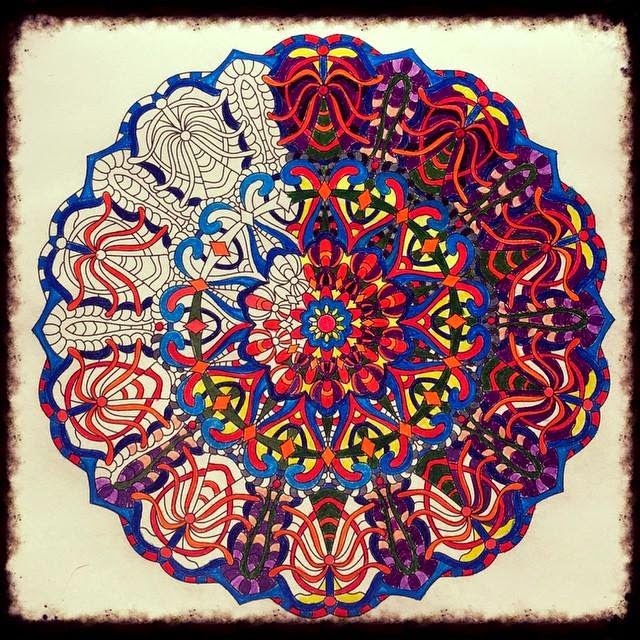
Mandala by Nandu 
  Through my own initiation into the world of coloring, and journeys down rabbit-holes, I have come to ponder over some questions about art:

Is photography an art? Few would deny that photography is a pursuit that requires skill to compose good quality portraiture and scenery. It is an art, but one that has been made easy for the dilettante to engage in, thanks to digital technology. But there was a time in our history when all portraits and pictorial representations of scenery were only ever hand drawn and painted. Does that make photography a faux art?

LotusMandala by Nandu
     The appeal of adult coloring books is that it caters to the artistically inclined whose talents do not include imaginative drawing. I am a prime example of someone in this category. Pre-drawn designs allow me the opportunity to exercise my skills in color composition and combination, something I would be unable to engage in if I had to produce the designs on my own.  Since I didn’t draw what I colored, there are questions of ownership and authenticity:

If the finished piece is not entirely your doing, can you truly say that it is yours? My post on social-media of my first colored design received many compliments that prompted me to question whether I deserved the praise. After all, I had “only” colored inside the lines. My early opinion on this matter went along with the notion that if I had not drawn the design to begin with, the finished picture would somehow not be authentically mine. On the surface, this seems to be a logical perception, but perhaps a more nuanced view is required.

     Is a collaborative piece of art  (where you draw, and I color) less authentic than one done entirely by a single individual? If Da Vinci had captured the Mona Lisa smile with his Pentax instead of his paintbrush, would he have been a lesser artist?

From Secret Garden by Prue Jack, Founder of Inside The Lines

From Secret Garden, by Prue Jack

Night at the Secret Garden, by Prue Jack

  If collaboration, or reliance on technology disqualifies something as being authentic, then all art is in trouble. Every artistic endeavor is, to some extent, collaborative when compared to how the art was practiced in previous generations. Artists of today have a phenomenal array of paints, and brushes and pens and other paraphernalia to choose from.  But in the years before tube paints were manufactured, artists had to fashion their own tools, and mix their own colors. Being an artist entailed knowing how to mix paint, knowing the properties of pigments (their hue, chroma, light-fastness, compatibility with other pigments, drying attributes etc.) and a range of other skills connected to making fresh paint every day. Today’s artists need only to walk into an art store where paints and other artists’ tools are supplied, ready-to-use, with impressive choices - however, for impressive prices too!

   Having a relatively easier task compared to prior generations does not invalidate the existing skills that are put into use in creating a work of art. New categories of art are born out of advances in technology and the availability of material that previously didn’t exist – such as in the case of photography. Similarly, the term colorist is now being used to describe artists who color pictures drawn by someone else.

   Thus “collaborating” with Johanna Basford or Angie Grace does not make your artistic work any less authentic. There is a lot of room for creativity when interpreting ready-made drawings. Below are different renditions of the same drawings that I hope will illustrate this point:

Basford Heart, by Nandu

Basford Heart, by Prue Jack


Coloring inside pre-drawn lines is a fine art. But it is one that anybody, of any skill level can attempt. I dare you to try your hand at it once, and then resist the desire to do more!

Links:
On Facebook:
Inside The Lines – A coloring group where you can post your pictures, see what others are coloring, get links to free downloads to print and color, and information on resources etc. Join us!

Color With Angie Grace - A group devoted to sharing colorings from Angie Grace books only.


Saturday, March 7, 2015

The Unbearable Righteousness of Being Indian ~ On the Documentary, India's Daughter


India has done it again.  We are reliving the brouhaha after Slumdog Millionnaire.
And once again the messenger has been shot because she is white.

The Indian government has banned Leslee Udwin’s documentary, India’s Daughter, about the brutal 2012 rape in Delhi (and subsequent death) of J.S., a 23-yr old student. This gruesome incident galvanized a generation of youth in India, men and women alike, to protest against violence towards women. Udwin’s motivation to make the documentary came from this very phenomenon of a peaceful uprising by the youth demanding some accountability. The protests in Delhi (and other cities) were the first of their kind in India – a voluminous show of solidarity among the youth to counter the ever-present predation of women. An additional impetus to make the film comes from the desire to get to the root of violence against women, and rape in particular. As a victim of rape herself, Leslee Udwin wanted to shed light on the broader causes of such violence. On a televised forum she said she viewed cases like the 2012 Delhi rape as symptoms of larger causes. The film is her contribution to helping unravel the source of such heinous symptoms.

The film has extensive footage of interviews with the parents of the victim. In the film, we get to see, in direct terms, the loss of the daughter through the parents’ eyes. And through a friend of J.S’s, we get a window into who the victim herself was. As it is illegal to disclose the name of a rape victim in India, in the early aftermath of the incident, the victim was dubbed Nirbhaya (one who is without fear) - a tribute to her fighting the rapists, and her tenacity to hang onto life for a few days, despite the horrific extent of her injuries. If there is any subtle message that this documentary tries to imbue, it is to re-inforce that Nirbhaya’s life and aspirations were so violently cut short for no good reason. If you followed the news about this rape in 2012, there is nothing of “shock value” that the documentary adds. And it doesn’t aim to.  Aside from a few gruesome details about J.S’s injuries that may not have made it to the newspapers in 2012, there is nothing new that we learn.

The documentary contrasts the life of J.S. (as seen through the eyes of her parents and her friend,) with the viewpoint of a few in the Perpetrator Camp. Considerable camera-time is given to Mukesh Singh, one of the accused, - the driver of the bus.
The film showcases the mindset of not just Mukesh Singh, but his lawyers too. We get to see that there is not an iota of remorse in the words of Mukesh Singh - nor in his tone or demeanor. He, along with his lawyers, squarely blames the victim for all that she endured.

Despite the film being banned, the extremely misogynistic opinions of Mukesh Singh and his lawyers are plastered across print media in India for all to read. There is nothing new you will learn from the film that you don’t already know.  The film is merely a reminder, or rather, a confirmation, of your worst fears: That misogyny is all-pervasive. That it is not restricted to a few depraved souls, nor is it the result of poverty or a lack of education. It has firm roots in the Indian psyche.

Weeding out something that is so deeply ingrained seems near impossible, especially in this culture of righteousness that has taken a renewed hold of India.
Awareness is the first step to rooting out social ills. So if you have nothing to contribute to this latest discussion on gender violence, please stay out of it. But don’t sabotage the efforts of those who choose to make themselves more aware.

Righteousness is a cultural value ascribed especially to the Indian Woman. It has been glorified, sought after voluntarily, or fed down unwilling women’s throats for several generations past. The Indian woman who deviates from this path of righteousness deserves what she gets! That is the essence of the message from Mukesh Singh and his educated lawyers.

Some commentators on social media are dismayed that the perpetrators were given a platform to air their malignant thoughts. If you were offended by Mukesh Singh's lack of remorse, perhaps you should direct some of that affront towards meaningful change: towards changing the attitude of victim-blaming. Begin by allowing people to watch the film and make themselves doubly aware that victim-blaming exists, and that it transcends boundaries of caste, class and education.

In recent months, several countries have issued travel advisories to their women citizens wishing to travel solo to India: ~ Don’t! A spate of rapes in cities across India of foreign women travelers is what has led to this separate but common warning. It is easy to see that these warnings stem from a desire to keep female citizens of those countries safe, in the face of a spurt in violence against foreign women. Nobody (with any degree of credibility) would cite these warnings as instances of Gender Policing.
Gender Policing is when there is an enforcement of gender-normative behavior on an individual. Gender policing works to delegitimize and devalue behavior and expressions that deviate from the gender norm. Victim-blaming in rape is a prime example of gender-policing. Having the opinion that women bring about their own destruction by wearing certain clothes and going out after sunset is gender policing.

The problem with identifying and eradicating gender policing behaviors in a climate of violence against women is that they are hard to recognize because they overlap with common sense rules for safety. In places where there are high crimes against women, even the most liberal person might recommend to daughters and sisters that they should watch for their safety by not engaging in behaviors that might leave them vulnerable to attack. In gender policing, misogynists say the same thing: Don’t engage in certain behaviors. The difference is that in gender policing you are punished if you do. Rape and honor killings are examples of punishments meted out to those who stray from gender- normative behavior.
This message is loud and clear in India’s Daughters. The words of Mukesh Singh and his two lawyers make it amply clear that their thinking is not that of eccentric outliers. It is alarmingly main-stream. One lawyer uses the metaphors of “diamond” and  “flower” for women. The other lawyer declares, without hesitation, that he would pour petrol on his daughter and burn her alive for defying ascribed gender-roles.

When you shed the coat of vulnerability and submissiveness that you are given by being born female, you are stepping out of the role ascribed to you. Victim-blaming will always exist so long as submissiveness and vulnerability are considered womanly virtues. So the next time you caution your daughters and sisters to “stay safe,” be aware that your message mirrors that of gender policing misogynists. Distance yourself from this overlap, even if it is only mentally.

 The Nirbhaya case has certainly become the 21st century symbol in India, of violence against women. It has forced discussions about gender disparity like no other single incident has. For that very reason, to critique a film about this landmark crime on artistic grounds and on its merits as a documentary is misguided. To ban it and prevent people from watching it is irresponsible. If the Indian Government has embarrassed itself (again) by this ban, the redeeming factor is that there are many who are protesting the ban.
My desire to watch the film was not for entertainment. I didn’t care if the documentary was not nuanced enough, or if things were over-dramatized, as some critiques imply. For me, it was one more source of information that adds to the mish-mash of material that contributes to making sense of so many contradictory forces in the Indian mindset.

India is full of empty clichés of female power: Bharat Mata (Mother India), Durga Devi, Kali Mata, Shakti Devi and innumerable goddesses in mythology. If it’s money you seek, honor Goddess Lakshmi. Pursuing the Arts? First, a blessing from Saraswathi, Goddess of Knowledge and Arts! On this eve of International Women’s Day 2015, forget these imaginary forces of power: Worship the real women in your lives!